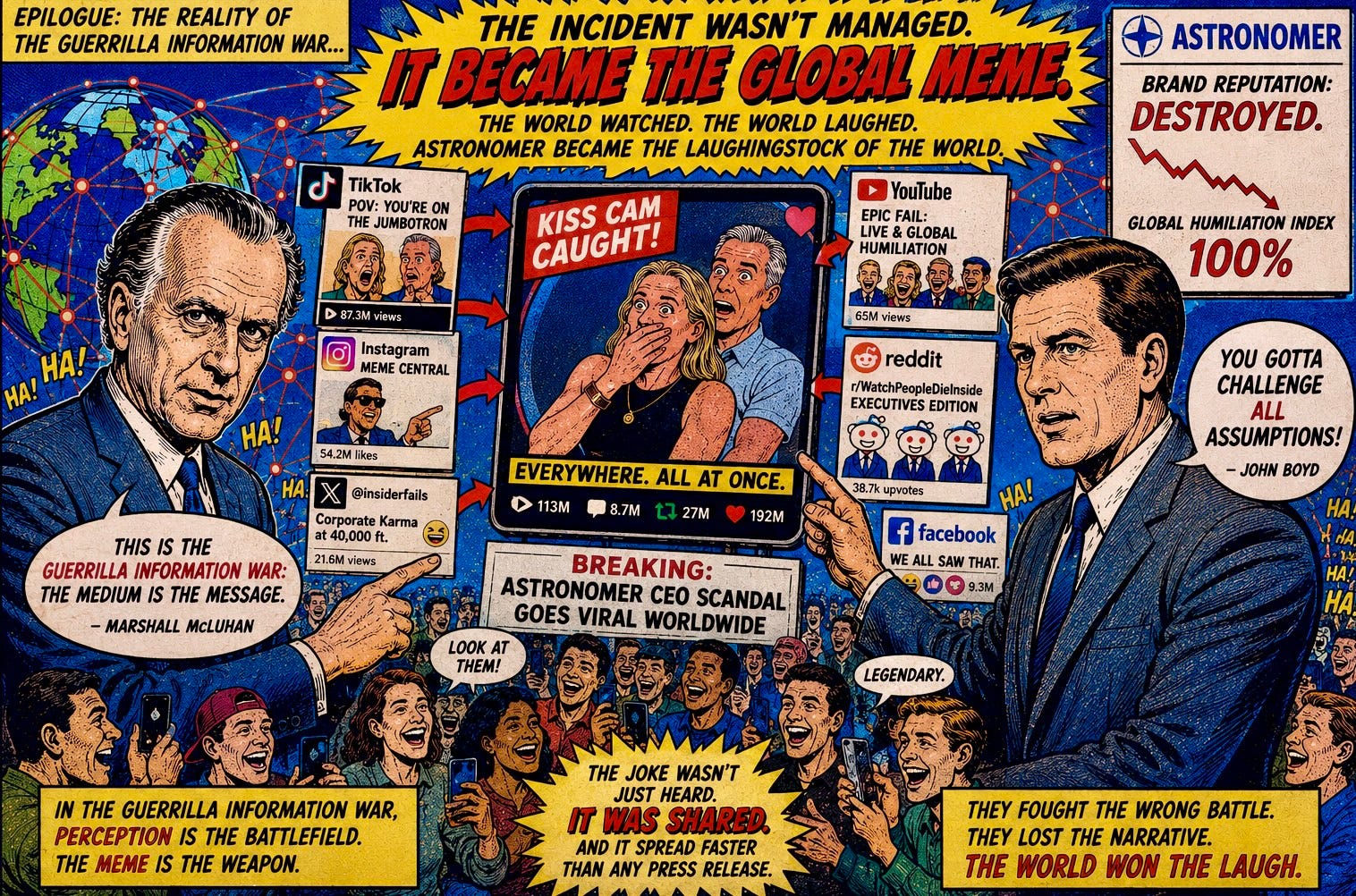
Your Crisis Response Was Flawless. Your Read Was Not.
The Perception Failure Hiding Inside Every "We Need to Communicate Better" Meeting

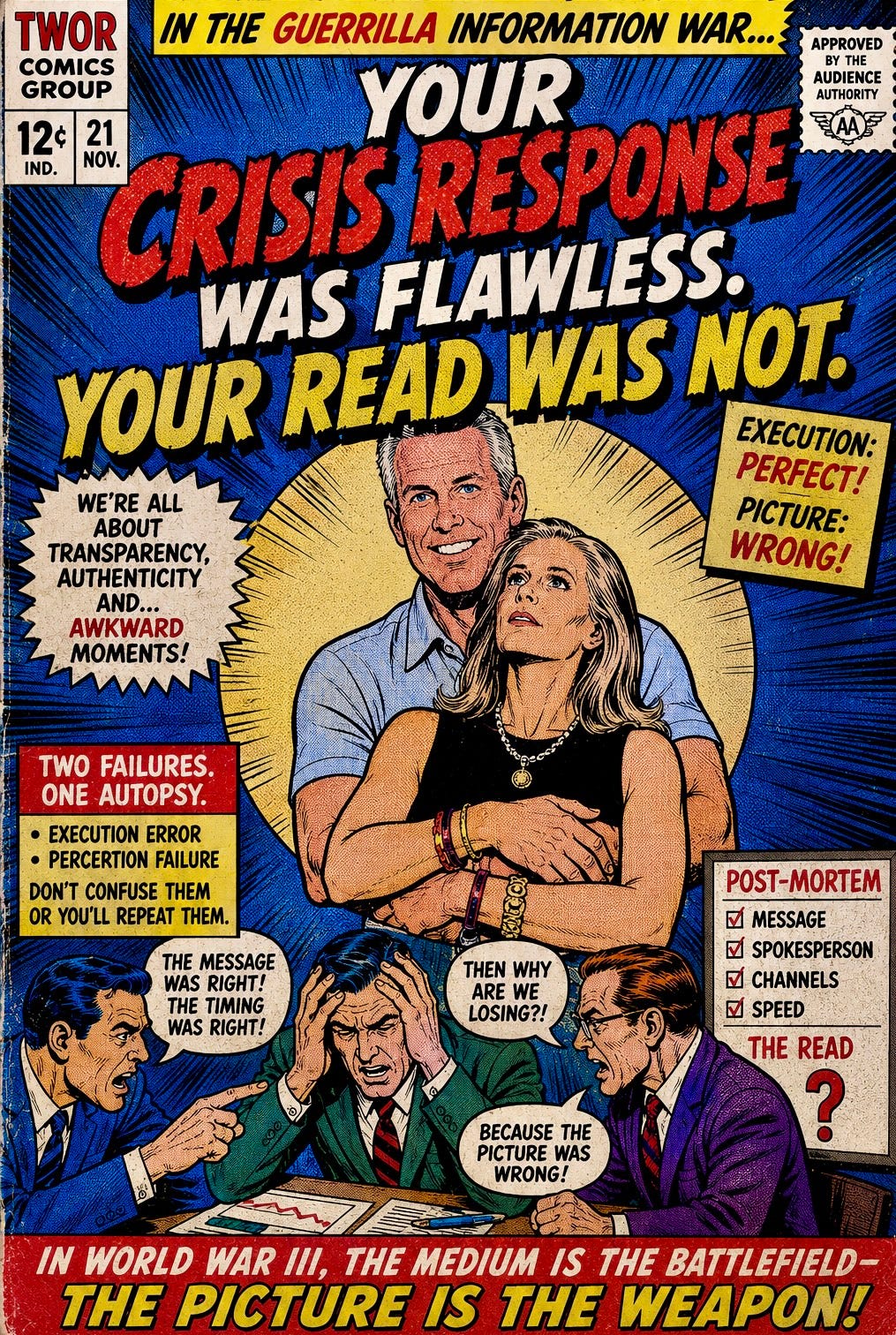
Astronomer’s Gwyneth Paltrow video was a competent piece of work. Polished production. Clever casting — the meta-layer with Chris Martin all but written into the script. Fast turnaround. Wide distribution. By every standard production metric, this was professional corporate communications doing what it’s supposed to do.
It also failed completely.
Not because of the execution. The execution was fine. The picture driving the execution was wrong. Their leadership was responding to a situation they had not actually read. I wrote about this when it happened — the breach was moral, not visual, and they answered it with branding. They were trying to meme with marketing. The medium was mismatched. The narrative was missing. The response was crisp. The picture was wrong.
These are two different failures, and almost no post-mortem in corporate communications can tell them apart.
Two failures, one autopsy
An execution error is a bad response to an accurately read situation. The read was right. The choice was wrong. Choose differently next time, and the problem doesn’t recur. This is the failure mode every playbook, every after-action review, every corporate communications post-mortem is built to find. It’s the failure mode that the discipline knows how to fix.
A perception failure is something else entirely. It’s any response — even a competent one, even an excellent one — to a situation that was never accurately read. The choice may have been textbook. The execution may have been flawless. None of it matters because the picture didn’t match the territory the choice was landing in. Better choices on the same picture get you nowhere. Faster choices arrive at the wrong destination faster.
From the outside, the two failures look identical. Same bad outcome. Same furious board. Same firings. Same press cycle. The post-mortem opens, the questions get asked, the lessons get extracted, and everyone goes home satisfied that the system has learned. It hasn’t. If the failure was upstream of execution, the post-mortem looked in the wrong place — and the same failure is now scheduled to happen again, in a different costume.
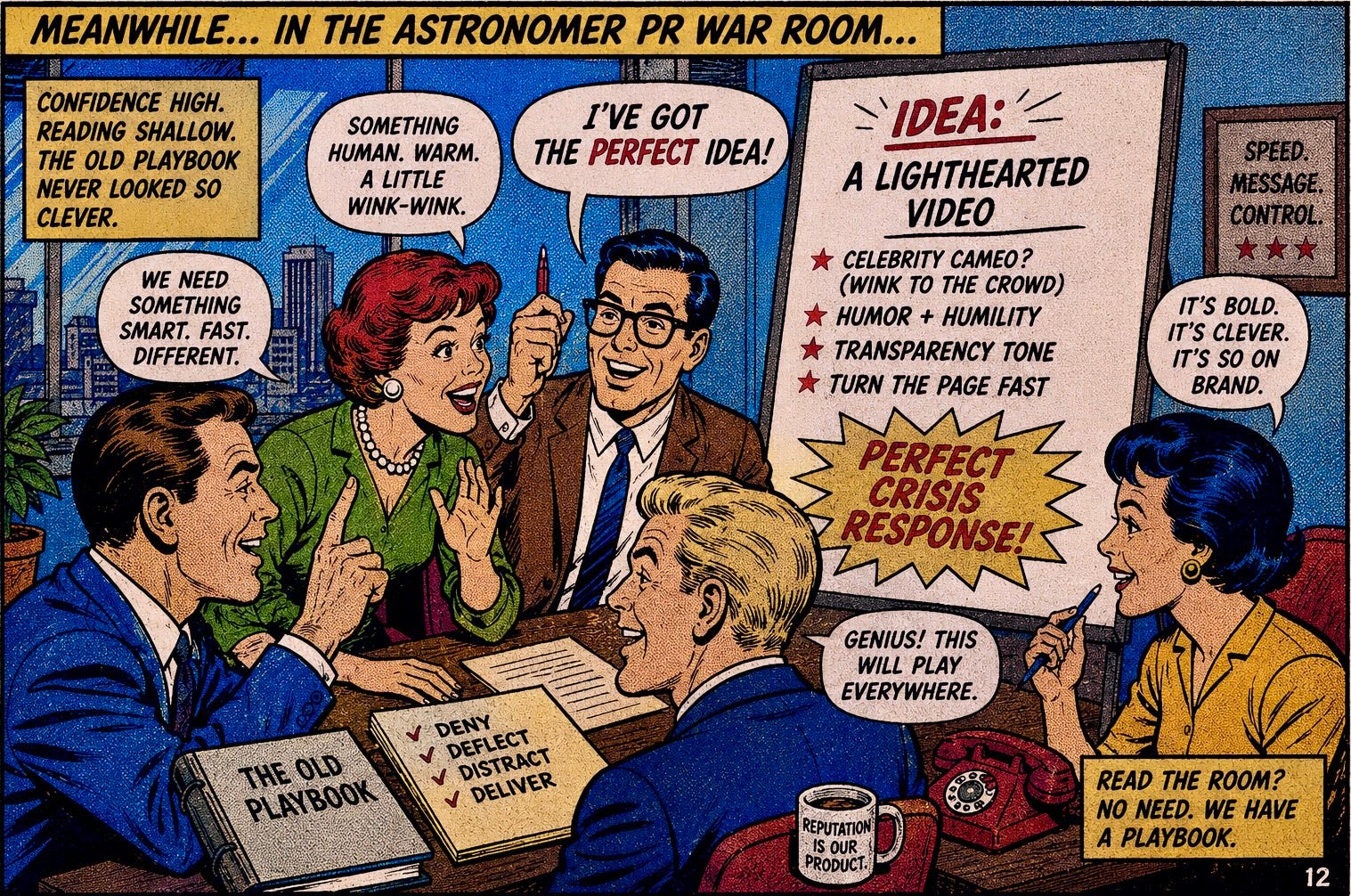
Why typical post-mortems miss this almost every time
Sit through one of these classic post-mortems. The questions all point in the same direction. Did we follow the plan? Was the message right? Were we fast enough? Right channel. Right spokesperson. Right timing. Did the functions talk to each other?
Notice what’s missing.
Nobody asks if we read the room right to begin with. The picture we were working from never gets touched. We just take it apart — the response — piece by piece, like the picture was a given. But if the picture was wrong, so was everything downstream of it, and the meeting can run for three hours without ever brushing up against the actual break.
This is the distinction at the bottom of the five failure patterns I wrote about recently. Lag, Lock, Fragmentation, Capture, Stasis — none of them are execution problems. All of them are picture problems. And every one of them produces a post-mortem that looks at the response, finds plausible execution improvements, implements them, and watches the same pattern reassert itself nine months later because nothing was fixed at the layer where the failure actually lives.
Boyd’s OODA sketch — the real one, not the linear loop — is built around this. Orientation isn’t a step between observation and decision. It’s the active formation of the picture from which everything else is being done. When orientation is off, the rest of it can be flawless and you’ll still lose. Speed won’t save you. Discipline won’t save you. A better playbook won’t save you. The picture is upstream of everything you can fix downstream.
How to spot which one you’re in
Three tells that the failure is upstream of execution.
The first is that the response did exactly what it was designed to do, and the outcome got worse. Astronomer’s Gwyneth video performed. It got the views. It got the attention. The brand metrics it was built to move, it moved. And the underlying situation — the credibility collapse, the unanswered questions about culture and accountability — got worse, not better, because the response confirmed that leadership still didn’t understand the situation. When competent execution makes the problem worse, the problem isn’t execution.
The second is that people closer to the situation kept saying things that weren’t being absorbed. There’s almost always someone — a junior staffer, a customer service lead, a regional manager, a contractor who works with the actual audience — who had the right read and couldn’t get it heard. Their input arrived, was logged, and bounced off the picture that leadership was already committed to. After the failure, they’re the ones who say “I told them” — and they did. The picture filtered the signal out before it could reach the ground. That filtering is the failure, and it happened upstream of any response.
The third, and the most reliable: the first instinct after the failure is “we need to communicate better,” not “we need to look again.” That sentence is the tell. It assumes the diagnosis is downstream. It assumes the problem is in the channel, the message, the spokesperson, the timing — anywhere except the read of the situation that produced all of those choices. “We need to communicate better” is the autopilot response of an organization that cannot see its own picture and therefore cannot see that its picture failed.
The right post-mortem question
Not what did we do wrong in the response. Try this instead:
What picture were we operating from? Where did that picture come from? When was the last time we actively tested it? And how does it differ from what was actually happening?
Those questions land upstream of execution. They force orientation back into the conversation. They expose the gap between how the organization understood the situation and how it actually was. Sometimes the gap is small and the failure was really downstream — that’s an execution error, and the standard post-mortem is the right tool. More often, the gap is large, the picture has been drifting for a while, and the organization has been running competent responses to a situation that no longer exists.
McLuhan said we move into the future watching from the rearview mirror. Each new world gets seen in the categories of the world that just ended. I’ve written about this — it’s a hardwired cognitive failure, not a flaw in any particular leader. The default state of a professional operating under pressure is to read the current situation through the lens of what worked last time. Most of the time, it’s close enough. When it isn’t, no amount of execution discipline closes the gap.
What this changes
Fix the picture, and a whole class of failures stops repeating. Not because your responses get better — they may not — but because your responses are now landing in the situation you’re actually in. Competence at the response layer is necessary. It is never sufficient. Sufficiency is upstream.
The hard part isn’t the fix. The hard part is the willingness to look at what you were actually seeing instead of what you were trying to see. Most leaders, most teams, most communications functions cannot do this without a forcing function. The forcing function is what comes next.