
Your OODA "Loop" Is Fast and Intact. Your Orientation Is Gone.
Five failure patterns that feel like stability until they don't.

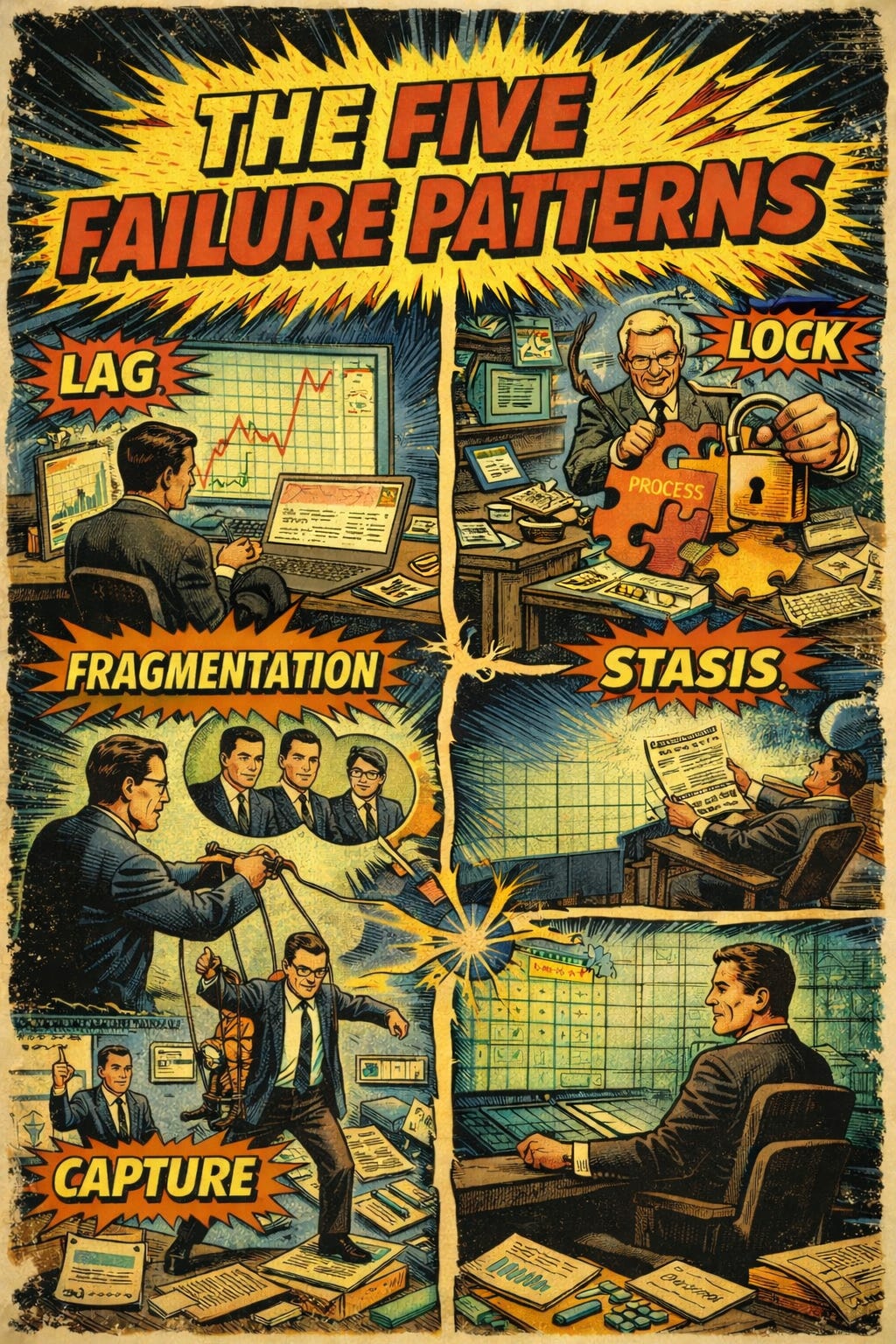
Orientation fails in patterns.1 Not randomly. The same failures keep showing up, each one recognizable in hindsight and invisible while it’s running. They share a common root — when the deliberate work of generating mismatches stops, when the model stops getting tested against what’s actually out there, something fills the space. Five patterns. None of them separate diseases. Five ways the same failure expresses itself when the destruction-and-creation cycle goes dark.
Lag is the most common and the least dramatic. The model stops updating at the rate at which the environment is changing. Internally, everything still makes sense — the decisions are coherent, the strategy holds together, the culture feels intact. What has moved is the ground underneath. The market shifted. The competitor changed. The assumptions that drove the last round of decisions aged out quietly while the decisions kept coming. The organization isn’t lost. It’s precise about something that no longer exists. You see lag in the pattern of surprises — things that blindsided the organization but that, looked at afterward, had been signaling for months. The orientation wasn’t up to date enough to receive them.
Lock arrives through success. The formula that produced the win hardens into doctrine, then into identity. The organization stops being able to perceive the conditions under which the formula stops working, because the formula has become the frame through which all conditions are perceived. Disconfirming observations don’t register as disconfirming — they get processed as noise, as temporary aberration, as adversary error, as anything that preserves the structure rather than threatening it. The locked organization doesn’t feel rigid from the inside. It feels like it has standards. That’s the trap.
Fragmentation isn’t a single degraded orientation. It’s three or four of them running at the same time, each one certain it’s the real picture. Finance is reading one environment. Product is reading another. Sales is somewhere else entirely. None of them is wrong about everything. That’s what makes the whole system so difficult to move. Without shared orientation underneath, none of it generates naturally. Coordination requires constant oversight. Cooperation has to be extracted. Coherent action needs someone at the center calling it — without that, nothing holds. Fragmentation is where you feel it first. In the friction, before you can name it. It can also be the result of deliberate action by an adversary who understands your orientation better than you do — ambiguity generated from outside, seeding incoherence in what was previously aligned. An organization under fragmentation cannot always determine which is operating. That inability is precisely what makes it exploitable.
Capture is the most dangerous because it is the least visible from inside. An external actor — a competitor, a dominant customer, a consulting paradigm, a media narrative — has systematically shaped the organization’s perception to serve that actor’s interests. The organization believes it is reading the environment. It’s reading someone else’s version of the environment. The categories it uses to size up competition, the metrics it runs on, the story it tells about where it sits in the market — somebody else built those. And that somebody has different interests. The signature of capture is that the organization consistently interprets its environment in ways that serve someone else. It can’t see this from inside because the capture operates at the frame level, not the content level. You can’t question the lens with the lens. Like fragmentation, capture can be drift or the result of deliberate action by an adversary who understands your orientation better than you do. From inside the organization, experiencing it, the two are functionally identical.
Stasis needs no external trigger. Only the absence of the ongoing work — the testing, the questioning, the willingness to break what no longer fits. The model may have been accurate when it was built. It decays relative to a complexifying environment without any single moment of failure that could serve as a warning. Stasis feels like stability. The numbers are acceptable. The team is capable. There is no evident crisis. What’s missing is a novel response — the organization applying established approaches to conditions that have already moved past them. The gap keeps growing. Invisibly, then not.
The five are not sequential, and they are not mutually exclusive. An organization in lock will develop lag as the locked formula ages. A fragmented organization is more vulnerable to capture — different fragments pulling in different directions, each one available to a different external actor. Stasis can precede or follow any of them. What connects the five is quieter than a list of shared properties. The destruction-and-creation cycle has stopped. The gap is opening. It opens on its own schedule in each case, faster or slower depending on how the environment is moving and how long the organization has been standing still. It can get there through neglect alone. An adversary who has carefully read your orientation can get it there, too.
The detection problem stays open. No threshold resolves it. Nothing fires cleanly before the mismatch has already compounded enough to be undeniable. The only thing that works — before the mismatch is quantifiable, before it’s even nameable — is the same discipline that prevents the failure modes from developing in the first place: the continuous, deliberate generation of mismatches before you can quantify them. Certainty about the current orientation is not a destination. It is the earliest warning sign that the work has stopped.
With deepest thanks to Chet Richards and G.I. Wilson, whose counsel, generosity, and decades of commitment to John Boyd’s work helped me make this article better than I could have alone.
Could you provide real world examples of each? I like the insights, but but some stories of each would be appreciated.
Excellent insights!